Pentecost – A Yahwehist Perspective
As most are aware, the countdown to Pentecost, a.k.a. Festival of Weeks, begins on the day after the weekly Sabbath day which occurs during the 7-day Festival of Passover/Unleavened Bread.
The count which begins on the 1st day of the week culminates on the day of Pentecost 50 days later, also occurring on the 1st day of the week, Sunday.
A question that might be asked is, Does Yahweh even require us to observe Pentecost and if so, what does all this mean in the bigger picture? If you’re interested in finding out then just continue reading.
Before Mount Sinai
First of all it would be helpful to know if the laws, commandments, and statutes of Yahweh were kept before the Torah/Law (Old Covenant) at Mount Sinai was given in the Old Testament. Important to note is the fact that Abraham was blessed by Yahweh:
Because Abraham obeyed my (Yahweh’s) voice, and kept my charge, my commandments, my statutes, and my laws. (Genesis 26:5)
We should also recognize that the weekly Sabbath day and the Festival of Unleavened Bread (added designation of Passover instituted during the Exodus) were observed before the Torah at Mt. Sinai.
Besides the preexisting 10 commandments given in the Torah at Mt. Sinai are the preexisting statutes of the festivals:
Three times in the year you shall keep a feast to me. You shall keep the FEAST OF UNLEAVENED BREAD; as I commanded you, . . . You shall keep the FEAST OF HARVEST, of the first fruits of your labor, of what you sow in the field. You shall keep the FEAST OF INGATHERING at the end of the year, when you gather in from the field the fruit of your labor. Three times in the year shall all your males appear before the sovereign Yahweh. (Exodus 23:14-17)
Torah of Trust
Therefore, since Abraham was under the Torah of Trust and not under the works of the Torah of Moses made at Mt. Sinai, we, like Abraham, are required to keep the same laws, commandments, and statutes that Abraham kept.
Keep in mind, since the death of the messiah, we are no longer under the works of the Torah of Moses (Rom. 6:14-15; Gal. 2:16, 3:10, 23, 4:4-5, 5:18), but we are under the Torah of Trust of Abraham (Rom. 3:27-28, 4:1-16; Gal. 3:6-9).
And he (Abram) trusted in Yahweh; and he reckoned it to him for righteousness. (Genesis 15:6)
Additionally we know that Pentecost was still being observed after Yahushua the messiah’s death.
For Paul had determined to sail by Ephesus, because he would not spend the time in Asia: for he hasted, if it were possible for him, to be at Jerusalem the day of Pentecost. (Acts 20:16)
Torah of Moses/Old Covenant
Now that we have some preliminaries out of the way, this study has utilized the chronological research regarding the Exodus to conclude that the Torah of Moses/Old Covenant was given at Mt. Sinai on the day of Pentecost. Just so happens that many ancient and modern researchers have determined the same conclusion.
It is important to note the reason for the Torah of Moses/Old Covenant:
Why then the Torah? IT WAS AN AUGMENTATION FOR THE SAKE OF TRANSGRESSIONS, until should have come the sperma (collective seed, the elect) to whom the promise has been made. (Galatians 3:19)
One must recognize that the Torah given at Mount Sinai was a marriage covenant between Yahweh and the nation of Israel which was brought about due to Israelite transgressions against the Covenants of Promise.
The Torah of Moses was used to teach the Israelites what sin (transgression) was, thereby revealing in written form the conditions of the earlier verbal Covenants of Promise (under Torah of Trust) made with Abraham. It merely put into writing those original conditions and augmented them with judgments.
Works of the Law
Nevertheless, the Israelites continued to break their marriage vows. As a result, under the condition to obey Yahweh’s voice, the Old Covenant was further augmented with what became known as the “works of the Law” thereby making it impossible for anyone except Yahushua to keep the Torah of Moses.
Knowing that a man is not justified by the works of the law, but by the trust of Yahushua messiah, even we have trusted in Yahushua messiah, that we might be justified by the trust of messiah, and not by the works of the law: FOR BY THE WORKS OF THE LAW SHALL NO FLESH BE JUSTIFIED. (Galatians 2:16)
New Covenant
The fulfillment of the Covenants of Promise will result in the making of the New Covenant (Torah of Trust) with the elect (σπερμα; sperma, collective seed) of the First Resurrection at the Festival of Pentecost (Galatians 3:19).
It is important to recognize that like the Old Covenant marriage at the Festival of Pentecost with the Israelites during the Exodus, the future New Covenant marriage/betrothal will take place at the Festival of Pentecost, only this time with the elect of the First Resurrection. It is also important to note that the consummation of this marriage/betrothal of the New Covenant will happen at the end of the Judgment Millennial Day (the 8th Millennial Day) when father Yahweh arrives.
Behold, the days are coming, says Yahweh, when I will make a NEW COVENANT with the house of Israel and the house of Judah. (Jeremiah 31:31)
Blessed are they which are called unto the MARRIAGE SUPPER of the Lamb. (Revelation 19:9)
Unlike the marriage of the Old Covenant the elect will not break their marriage vows under the New Covenant.
But this is the covenant which I will make with the house of Israel after those days, says Yahweh: I will put my law within them, and I will write it upon their hearts; and I will be their eloahim, and they shall be my people. (Jeremiah 31:33)
New Covenant Not Established Yet
For those who believe that the New Covenant has already been established, the book of Hebrews, written after the messiah’s death, would indicate otherwise:
In speaking of a new covenant he treats the first as obsolete. And what is becoming obsolete and growing old IS READY TO VANISH AWAY. (Hebrews 8:13)
In other words there is an expectation for the New Covenant (Torah of Trust) to take effect over the Old Covenant (Torah of Moses) at some future time. That time is when the New Covenant is established with the elect (24 elders and 144,000) of the First Resurrection which has not yet occurred!
Decrees Against Us Nailed To Stake
Keep in mind that the Torah of Moses will be used for teaching purposes until the very end of the 8th-Millennial Judgment Day (Matthew 5:18). Fortunately Yahushua, upon his death and resurrection, has provided us a different path than that of the Old Covenant whereby we can bypass the “works of the law” and come under grace.
Blotting out the handwriting of DOGMASIN (DECREES) THAT WERE AGAINST US, WHICH WERE CONTRARY TO US, and took it out of the way, nailing it to his stake. (Colossians 2:14)
For the law was given by Moses, but grace and truth came by Yahushua messiah. (John 1:17)
For sin shall not have dominion over you: for you are not under the (works of the) Torah (of Moses), but under grace (Torah of Trust). (Romans 6:14)
Notice importantly that in Colossians it was only the “handwriting of decrees that were against us” and “contrary to us” that were nailed to the stake, not the ones that were good for us.
The evidence from Scriptures indicates that the Festival of Pentecost is prophetically pointing to the establishment of the New Covenant by Yahushua with the elect of the First Resurrection thereby fulfilling the Covenants of Promise made to Abraham under the Torah of Trust.
Let’s take a look at some interesting facts from the New Testament.
Day of Wave Sheaf Offering
Yahushua was killed on the afternoon of Abib 14, Thursday, of the year 30 C.E. He was resurrected and quickened before sunrise on Abib 17, Sunday, the first day of the week. This day also happens to be the day of the Wave Sheaf Offering, the day that begins the count to Pentecost on Sunday 50 days later.
Also on Abib 17, Sunday, Yahushua ascended to father Yahweh:
Yahushua said unto her, Touch me not; for I am not yet ascended to my Father: but go to my brethren, and say unto them, I ascend unto my Father, and your Father; and to my deity, and your deity. (John 20:17)
Your attention will now be directed to the following verse regarding the account of Yahushua’s resurrection in the book of John:
Yahushua said unto her (Mary), Woman, why do you weep? whom do you seek? She, supposing him to be the gardener, said unto him, Sir, if you have borne him hence, tell me where thou hast laid him, and I will take him away. (John 20:15)
Think for a moment. Could it be that the reason why Mary thought that Yahushua was the gardener was the fact that he had in his arms the cutting of the wave sheaf? According to the Torah of Moses, the priest was to wave the sheaf of firstfruits of the harvest before Yahweh on the day after the weekly Sabbath of Passover Week (Leviticus 23:10-11).
In order to wave the sheaf of firstfruits (barley) one would have to cut the barley. In effect, when one cuts the barley it is being killed.
Elect Are Wave Sheaf Offering
Also, could it be that the possible wave sheaf that Yahushua was holding was symbolically the elect of the First Resurrection?
For example, according to the book of Revelation at the end of the 3 ½ year Tribulation Period the 2 prophets of Yahweh will be killed and be resurrected 3 ½ days later.
If the wave sheaf offering also represents the remaining elect (including the 2 prophets) being killed after sundown of Abib 17 then 3 ½ days later would bring us to just before sunrise Abib 20, this day being the last day of Passover Week/Unleavened Bread and the very day of the First Resurrection!
And I will give power unto my two witnesses, and they shall prophesy a thousand two hundred and threescore days, clothed in sackcloth. These are the two olive trees, and the two candlesticks standing before the deity of the earth. (Revelation 11:3-4)
And when they shall have finished their testimony, the beast that ascendeth out of the bottomless pit shall make war against them, and shall overcome them, and kill them. And their dead bodies shall lie in the street of the great city, which spiritually is called Sodom and Egypt, where also our sovereign was impaled. (Revelation 11:7-8)
And after three days and an half the ruach of life from the deity entered into them, and they stood upon their feet; and great fear fell upon them which saw them. And they heard a great voice from heaven saying unto them, Come up hither. And they ascended up to heaven in a cloud; and their enemies beheld them. And the same hour was there a great earthquake . . . (Revelation 11:11-13)
It is also interesting to note that Abib 20 is also the same day, just before sunrise, during which the Israelites passed through the sea in 1439 B.C.E. at the Exodus and the Egyptian army was destroyed! How do we know that? Going to have to cover that in another post, so patience is the order of the day.
Sacred Ruach Given
Regarding Abib 17, Sunday, of the year 30 C.E., the day of the omer wave offering, being the first day of the 50 days, also being the day of Yahushua’s resurrection, is when Yahushua breathed the sacred ruach upon his disciples.
When therefore it was late, on that day, the first day of the week, and when the doors were shut where the disciples were, for fear of the Jews, Yahushua came and stood in the midst, and said unto them, Peace be unto you. And when he had said this, he showed unto them his hands and his side. . . . Yahushua therefore said to them again, Peace be unto you: as the Father hath sent me, even so send I you. And when he had said this, he breathed on them, and said unto them, Receive you the Sacred Ruach. (John 20:19-22)
Now it’s time to address Pentecost of 30 C.E.
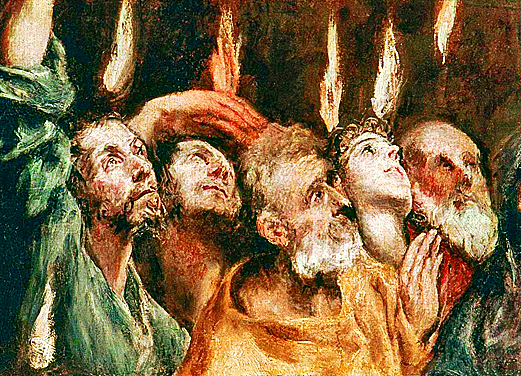
When the day of Pentecost had come, they were all together in one place. And suddenly a sound came from heaven like the rush of a mighty wind, and it filled all the house where they were sitting. And there appeared to them tongues as of fire, distributed and resting on each one of them. And they were all filled with the Sacred Ruach and began to speak in other languages, as the Ruach gave them utterance. Now there were dwelling in Jerusalem Jews, devout men from every nation under heaven. And at this sound the multitude came together, and they were bewildered, because each one heard them speaking in his own language. And they were amazed and wondered, saying, “Are not all these who are speaking Galileans? And how is it that we hear, each of us in his own native language? Parthians and Medes and Elamites and residents of Mesopotamia, Judea and Cappadocia, Pontus and Asia, Phrygia and Pamphylia, Egypt and the parts of Libya belonging to Cyrene, and visitors from Rome, both Jews and proselytes, Cretans and Arabians, we hear them telling in our own tongues the mighty works of the deity.” And all were amazed and perplexed, saying to one another, “What does this mean? (Acts 2:1-12)
According to Acts this was a partial fulfillment of a prophecy from the book of Joel:
But this is that which was spoken by the prophet Joel; And it shall come to pass in the last days, saith Yahweh, I will pour out of my ruach upon all flesh: and your sons and your daughters shall prophesy, and your young men shall see visions, and your old men shall dream dreams: And on my servants and on my handmaidens I will pour out in those days of my ruach; and they shall prophesy: And I will shew wonders in heaven above, and signs in the earth beneath; blood, and fire, and vapour of smoke: The sun shall be turned into darkness, and the moon into blood, before that great and notable day of Yahweh come: And it shall come to pass, that whosoever shall call on the name of Yahweh shall be saved. (Acts 2:16-21)
The Last Days
Pentecost in 30 C.E. occurred during the “last days,” the beginning of the “last days” commencing with the 5th millennium day of 8 millennium days, shortly after the start of the public ministry of Yahushua in 28 C.E.
The sacred ruach was poured out on the disciples with the result being that all the people of foreign nations could understand, in their own language, what was being said by the disciples. In regard to the other signs, they will also be fulfilled in the “last days,” during the 8th-Millennial Judgment Day.
The prophecy of the sacred ruach given on Pentecost cannot be missed as it applies to the First Resurrection and the elect. It is on this day that the marriage/betrothal of the lamb takes place with the elect along with their quickening into eternal beings.
They will have the gift of languages from the sacred ruach and their primary job will be to teach the nations, leading them to Yahweh during the 7th Millennial Rule of the messiah. The elect will continue with their job of teaching all the nations, all peoples from every nation having taken part in the Second Resurrection, during the 8th-Millennial Judgment Day.
Messiah Resurrects the Elect
It also cannot be missed that the elect are part of the body of Yahushua the messiah. The elect become united as one during the marriage/betrothal of the lamb. It is Yahushua who resurrects the elect on Abib 20, the last day of Passover Week/Unleavened Bread with the marriage taking place on the following Pentecost. Regarding Yahushua’s body Scriptures state:
The Jews then said to him, “What sign have you to show us for doing this?” Yahushua answered them, “Destroy this temple, and in three days I will raise it up.” The Jews then said, “It has taken forty-six years to build this temple, and will you raise it up in three days?” But he spoke of the temple of his body. When therefore he was raised from the dead, his disciples remembered that he had said this; and they believed the scripture and the word which Yahushua had spoken. (John 2:18-22)
Even the disciples understood the prophecy of the messiah and that it did not apply to the literal body of Yahushua. The reason being that Yahushua could not raise his own body, for he was dead. Father Yahweh raised Yahushua as Scriptures tell us.
Paul, an apostle not from men, neither through man, but through Yahushua the messiah, and Yahweh the Father, who raised him from the dead. (Galatians 1:1)
The Great Harvest
The goal for Yahushua along with the elect, his body, will be to lead as many people as possible to father Yahweh by taking part in the great harvest of the saved at the Festival of Ingathering at the end of the 8th-Millennial Judgment Day.
Before all this can happen the elect must be raised by Yahushua the messiah in the First Resurrection on the 7th and last day of Passover Week/Unleavened Bread. The elect will then be quickened into eternal beings and enter into the marriage of the New Covenant (Torah of Trust) with Yahushua during the Festival of Pentecost.
They will endeavor to help bring mankind to father Yahweh during the next approximate 2000 years, from the beginning of the 7th Millennium to the end of the 8th-Millennial Judgment Day when father Yahweh arrives to the earth to be married to his bride, New Jerusalem.
And I saw a new heaven and a new earth: for the first heaven and the first earth were passed away; and there was no more sea. And I John saw the holy city, new Jerusalem, coming down from Yahweh out of heaven, prepared as a bride adorned for her husband. (Revelation 21:1-2)
Much more can be said concerning this subject but we will have to continue our discussion in another post.
For more information regarding Pentecost and the Festival Days make sure you check out the publication by Qadesh La Yahweh Press titled “The Festivals and Sacred Days of Yahweh.”

 Passover – Introduction II