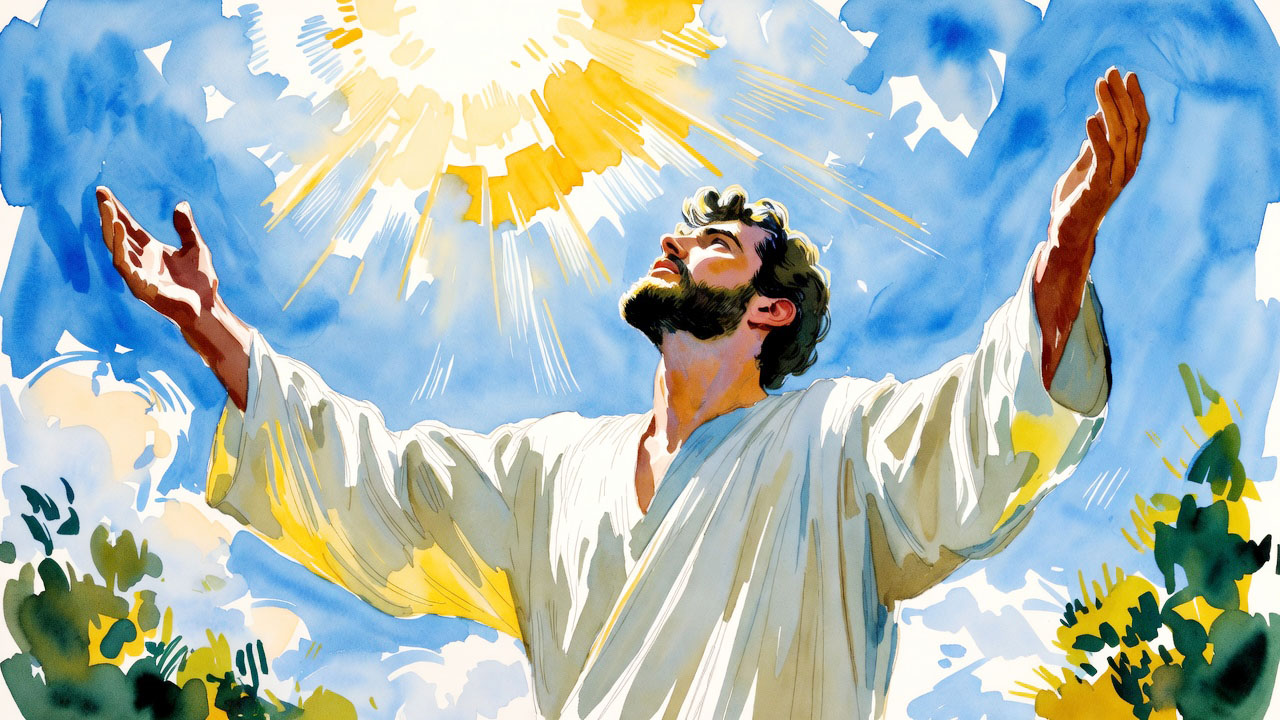
The Resurrected Body – Part 2

The Resurrected Body – Part 2

Like the Messiah’s Body
Saul notes that at the Resurrection we will obtain a body resembling the one Messiah had. More specifically, we are to acquire a body like the fleshly body Yahushua had while he was a man on the earth, before his resurrection from the dead, i.e., a ruach-type incorruptible fleshly body, one that was still mortal. Saul writes regarding the resurrected body:

It is sown a psuchikon (= nephesh-type) body; it stands up a pneumatikon (= ruach-type) body. There is a nephesh-type body and there is a ruach-type body. So also it has been written, the first man, Adam, created into a living nephesh; the last Adam into a living ruach. (1 Cor. 15:44-45)

Yet the first (Adam) was not the ruach-type, but was the nephesh-type. Afterward came the ruach-type. The first man was from out of the earth, made of earth; the second man, the sovereign, from out of the heavens.

As is the earthy, such also are those made of earth; and such as the heavenly one, such also the heavenly ones. AND ACCORDING AS WE BORE THE IMAGE OF THE ONE MADE OF EARTH, WE WILL ALSO BEAR THE IMAGE OF THE HEAVENLY ONE. (1 Cor. 15:47-49)

Notice that the body we will obtain after the Resurrection is like the one that the Messiah had when he came “from out of” the heavens, i.e., when he was transformed into a human, not like the quickened ruach-type body he had when he returned to the heavens. Continue reading “The Resurrected Body – Part 2”

The Resurrected Body – Part 1

The Resurrected Body – Part 1
Scriptures reveal two Great Resurrections from the dead, referred to as the First Resurrection and the Second Resurrection. This raises several important questions.
  • How is the divine aspect of our nephesh (the self or person) resurrected back to life?
  • What kind of body will we have when we return to life during either of these two Great Resurrections?
  • Will our body be flesh or spirit, mortal or immortal?
  • Does our new body get old and suffer from disease or does it remain forever young and vibrant?

Saul begins to address these questions in his first letter to the assembly at Corinth. He points out that some will ask the questions, “How are the dead raised? And with what body do they come?”1

Saul responds by dividing the process into two categories: Continue reading “The Resurrected Body – Part 1”

Tartaros and Demons – Part 2

In Tartaros and Demons – Part 1, we learned that the demon prison of tartaros is not so much a tahum under or within the depths of the earth as it is a dimensional region farthest away from the third heavens, the abode of father Yahweh.

We will now address the sinning angels, and more specifically, the Watchers, with their grievous sin of mating with human women and producing children who became giants.

Sinning Angels
The angels that sinned became known in Scriptures as demons and those angels who sinned most egregiously were placed in the prison of tartaros. For example, besides the act of setting themselves up to be worshiped,67 another blatant sin committed by the rebellious angels in the days prior to Noah’s Flood was adultery with human women.

The book of Genesis informs us: Continue reading “Tartaros and Demons – Part 2”

Tartaros and Demons – Part 1

The word τάρταρος (tartaros), under its verbal form ταρταρώσας (tartarosas; to thrust down into tartaros), is found only once in all of the Scriptures, at 2 Peter 2:4, “the deity did not spare the angels who sinned, but ταρταρώσας (tartarosas; thrust them into tartaros), keeping them in chains of darkness unto a κρίσιν (krisin; judgment; decision made by tribunal).”1 As James Orr writes, here tartaros “stands for the place of punishment of the angels.”2

S. D. F. Salmond similarly concludes, “the word is applied to the intermediate scene and condition of penalty in which those offenders are detained, held in chains of darkness, in reserve for the final judgment.”3

In neo-Christianity, the concept of tartaros, a word which primarily means “to incarcerate,” i.e., a place of incarceration in the deepest abyss,4 has been purposely blended with the following two concepts:

1. The pagan Greek notion of hades (the underworld of wicked immortal souls of the deceased).

2. A twisted interpretation of the scriptural concept of gehenna fire (the final punishment for the wicked). Continue reading “Tartaros and Demons – Part 1”

The Resurrections in Scriptures

We should be aware that Yahweh has predetermined much more for mankind than a simple existence as mortal, flesh-and-blood creatures.

However, few are mindful that Yahweh’s plan for mankind’s afterlife is predicated upon a resurrection from the dead. Indeed, in the book of Hebrews, the “resurrection of the dead” is declared to be one of the fundamental doctrines of Scriptures,1 one which is strongly proclaimed throughout both the Old and New Testaments.

Basic Doctrine
As previously stated, the doctrine of the resurrection of mankind from the dead is one of the fundamental themes found in Scriptures. To begin with, we are the work of Yahweh’s hands. Isaiah remarks:

And now Yahweh, you are our father; we are the clay and you are the maker, and we are the work of your hands. (Isaiah 64:7-8)

Yahweh’s intent for the work of his hands extends far beyond sheol (the state of death), even though the deceased person resting in sheol has reached a state of temporary nonexistence. Continue reading “The Resurrections in Scriptures”

Does Hell Exist? – Part 2

Quite opposite to the pagan notion of a conscious existence in a mythical underworld for immortal souls (whether Greek, Egyptian, Babylonian, etc.), there is no life or conscious existence in the sheol of Scriptures.

No Thought in Sheol
The following scriptural verses fully demonstrate the complete absence of thought in sheol:

Return Yahweh, rescue my nephesh; save me for your mercy’s sake; for there is no memory in death, in sheol who will give thanks to you? (Psalms 6:5)

What profit is in my blood in going down to the שוח (shuch; pit, grave); will you thank the ‘aphar? Will it (the ‘aphar) thank you? Will it declare your truth?(Psalms 30:9)

The above Psalms refer to the fact that after returning to the ‘aphar a dead person has no ability to thank anyone or receive thanks, for they are unable to speak or understand the speech of someone living. A parallel thought is expressed in the rhetorical question asked by Heman the Ezrahite. He notes that nothing can come from sheol, the land of נשיה (neshyah; oblivion)49 and the dark state of death. Continue reading “Does Hell Exist? – Part 2”

Does Hell Exist? – Part 1

What happens to a person when they die? Is it possible for one to be condemned to suffer for eternity in an underworld of fiery torment called hell? To answer, we must address the Yahwehist concept of the Hebrew word sheol, translated into Greek as “hades.”

The term sheol is found 65 times in the Old Testament and 10 times in the New Testament under the Greek form hades. Unfortunately, these two terms are commonly rendered as “hell” in the English translations.

Sheol is not, as popularly construed, a place where after death, the wicked dwell as conscious, thinking, disembodied immortal souls. Rather, it is a “state of being” for the deceased person (nephesh) of every human, whether just or unjust—a circumstance equated with darkness. It is not so much the “grave” where the remains of the nephesh lie, but rather the “state of the remains” within the grave. Continue reading “Does Hell Exist? – Part 1”