
 Many followers of Yahweh may be unaware of a remarkable source that provides evidence for the practice of the 7-day Festival of Passover and Unleavened Bread, which occurs from Abib 14 to 20.
This source comes from an extra-biblical work known as the Book of Yashar, or Sefer Ha-Yashar.
While the current copy of the Book of Yashar should not be considered authoritative like Scriptures, its insights regarding the Passover of the Exodus are nonetheless quite informative and interesting.
Book of Yashar
– 81:5 And the children of Israel TRAVELED FROM EGYPT AND FROM GOSHEN AND FROM RAMESES, AND ENCAMPED IN SUCCOTH ON THE FIFTEENTH DAY of the first month.
– 81:6 And the Egyptians buried all their first born whom Yahweh had smitten, and all the Egyptians buried their slain for three days.
– 81:7 And the children of Israel traveled from Succoth and encamped in Ethom, at the end of the wilderness.
– 81:8 And on the third day after the Egyptians had buried their firstborn, many men rose up from Egypt and went after Israel to make them return to Egypt, for they repented that they had sent the Israelites away from their servitude.
– 81:9 And one man said to his neighbor, Surely Moses and Aaron spoke to Pharaoh, saying, We will go a three days’ journey in the wilderness and sacrifice to Yahweh our eloahi.
– 81:10 Now therefore let us rise up early in the morning and cause them to return, and it shall be that if they return with us to Egypt to their masters, then shall we know that there is faith in them, but if they will not return, then will we fight with them, and make them come back with great power and a strong hand.
– 81:11 And all the nobles of Pharaoh rose up in the morning, and with them about seven hundred thousand men, and they went forth from Egypt on that day, and came to the place where the children of Israel were.
– 81:12 And all the Egyptians saw and behold Moses and Aaron and all the children of Israel were sitting before Pi-hahiroth, eating and drinking and CELEBRATING THE KHAG (FESTIVAL) OF YAHWEH.
– 81:13 And all the Egyptians said to the children of Israel, Surely you said, We will go a journey for three days in the wilderness and sacrifice to our eloahi and return.
– 81:14 Now therefore THIS DAY MAKES FIVE DAYS SINCE YOU WENT, why do you not return to your masters?
All sides can agree upon this much. The Israelites began their physical journey from Rameses to Succoth on Abib 15.
And the children of Israel journeyed from Rameses to Succoth, about six hundred thousand on foot that were men, beside children. Exodus 12:37
And they departed from Rameses in the first month, on the fifteenth day of the first month; on the morrow after the Passover the children of Israel went out with an high hand in the sight of all the Egyptians. For the Egyptians buried all their firstborn, which Yahweh had smitten among them: upon their eloahi also Yahweh executed judgments. And the children of Israel removed from Rameses, and pitched in Succoth. Numbers 33:3-5
Yashar 81:5 confirms that not only did the Israelites begin their physical travel on Abib 15, but they also arrived at Succoth the very same day.
– 81:5 And the children of Israel TRAVELED FROM EGYPT AND FROM GOSHEN AND FROM RAMESES, AND ENCAMPED IN SUCCOTH ON THE FIFTEENTH DAY of the first month.
Five Days Since
We will now advance to Yashar 81:12, where Pharaoh and his Egyptian army catch up to the Israelites in order to bring them back to Egypt.
– 81:12 And all the Egyptians saw and behold Moses and Aaron, and all the children of Israel were sitting before Pi-hahiroth, eating and drinking and CELEBRATING THE KHAG (FESTIVAL) OF YAHWEH.
According to the Book of Yashar, when the Egyptian army encountered the Israelites, they were celebrating the Festival of Yahweh. This festival could be none other than the last day of the Festival of Unleavened Bread!
It’s important to note that the last day of the Festival of Unleavened Bread begins at sunset, signifying the start of the day.
The Egyptians then stated the number of days that had passed since the Israelites started their journey from Rameses.
– 81:14 Now therefore THIS DAY MAKES FIVE DAYS SINCE YOU WENT, why do you not return to your masters?
The Hebrew text of Yasher 81:14 has:
ועתה הלא זה חמישה ימים היום שהלכתם
A more literal English translation would read:
“And now, is not this five days of the day of your going …?”
In other words, at the very time the Egyptians spoke to the Israelites, it was the fifth day of the Israelites’ departure from Rameses!
Doing the Math
Let us calculate the date of Abib, which marks the last day of the Festival of Unleavened Bread.
We will start our count from the day the Israelites began their journey from Rameses and count off 5 days of travel.
• Day 1: Abib 15
• Day 2: Abib 16
• Day 3: Abib 17
• Day 4: Abib 18
• Day 5: Abib 19
It is apparent that there is a significant problem with these dates.
According to the Book of Yashar, the Egyptians spoke to the Israelites on Day 5, the last day of the Festival of Unleavened Bread.
– 81:12 And all the Egyptians saw and behold Moses and Aaron and all the children of Israel were sitting before Pi-hahiroth, eating and drinking and CELEBRATING THE KHAG (FESTIVAL) OF YAHWEH.
Our countdown indicates that we cannot even meet the requirements for the Quartodeciman practice (System A), which involves a 7-day Festival of Passover and Unleavened Bread. According to this system, the last day of Unleavened Bread would fall on Abib 20.
This circumstance has more serious implications for the popular 8-day construct (System G), which most Sacred Name groups observe today, where the last day of Unleavened Bread occurs on Abib 21.
At this point in our analysis, one might conclude that the Book of Yashar contains errors and should be dismissed as lacking reliable facts for sound scriptural doctrine.
However, upon further reflection, it may be worth examining the Book of Yashar more closely, as it could be correct after all.
Egyptian Perspective
The first observation about the Book of Yashar is that it is written from a Hebrew perspective. This means that days are considered to begin and end at sunset, in accordance with Hebrew tradition.
In Yashar 81:13-14, it is particularly noteworthy that it is the Egyptians who refer to the number of days that have passed since the Israelites began their physical journey out of Egypt.
– 81:13 And all the Egyptians said to the children of Israel, Surely you said, We will go a journey for three days in the wilderness and sacrifice to our eloahi and return.
– 81:14 Now therefore THIS DAY MAKES FIVE DAYS SINCE YOU WENT, why do you not return to your masters?
Therefore, we should consider the days from an Egyptian perspective rather than a Hebrew one.
Unlike the Hebrew day, which begins at sunset, the Egyptian day begins and ends at sunrise!
It is now wise to reevaluate our thinking process regarding Yashar 81:14.
It’s important to remember that all evidence indicates the Israelites began their journey on Abib 15. They also would have departed during daylight hours, as indicated by the following verses in Scriptures:
And they departed from Rameses in the first month, on the fifteenth day of the first month; on the morrow after the Passover the children of Israel went out with an high hand in the sight of all the Egyptians. Numbers 33:3.
For the Egyptians buried all their firstborn, which Yahweh had smitten among them: upon their eloahi also Yahweh executed judgments. Numbers 33:4.
Not only did the Israelites leave in full view of the Egyptians, but the Egyptians were also burying their dead, suggesting these events occurred during the daytime.
With this understanding, we can now begin a new count using the Egyptian timeframe as follows:
• Day 1: Abib 15-16 Sunrise to sunrise
• Day 2: Abib 16-17 Sunrise to sunrise
• Day 3: Abib 17-18 Sunrise to sunrise
• Day 4: Abib 18-19 Sunrise to sunrise
• Day 5: Abib 19-20 Sunrise to sunrise
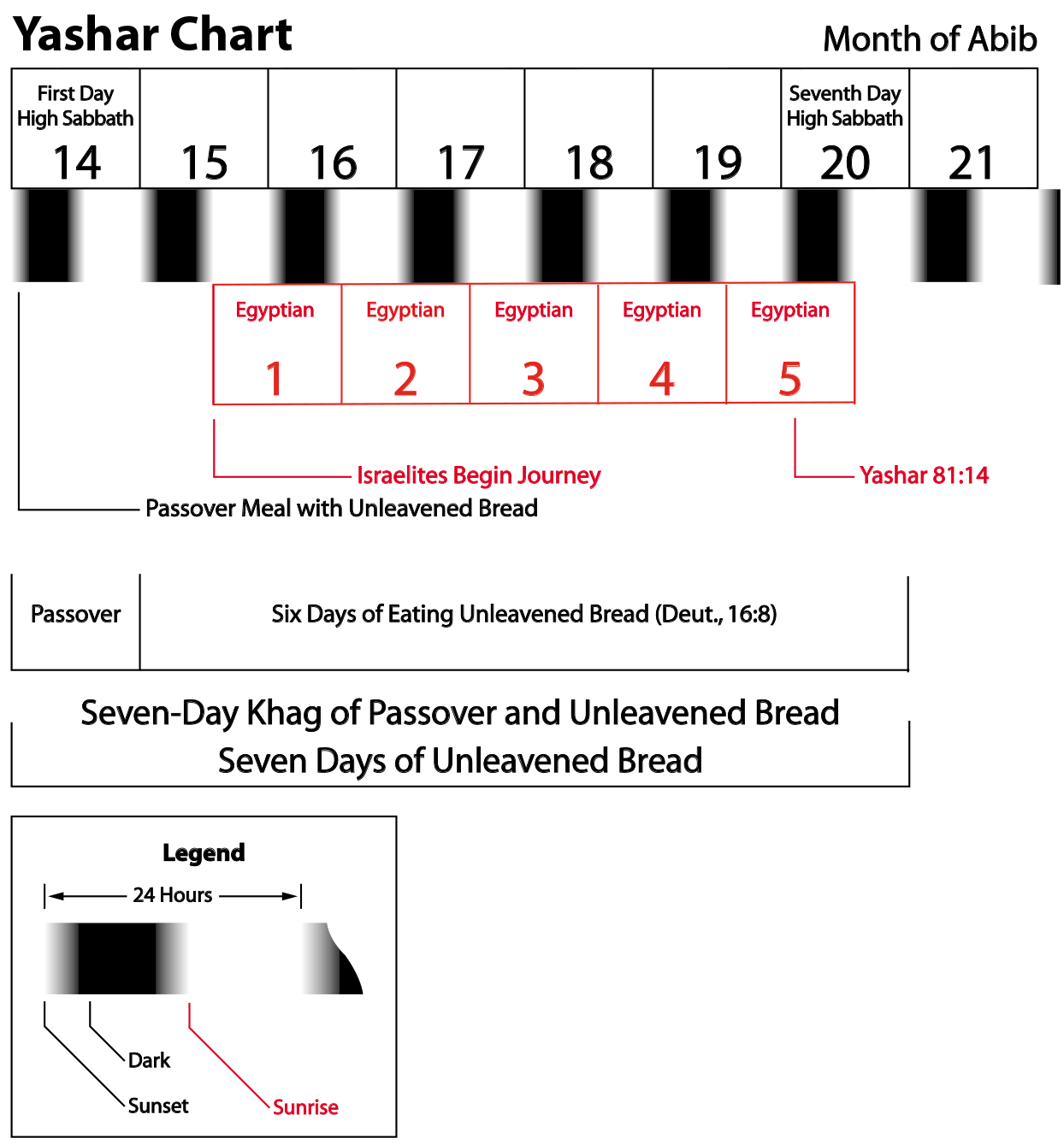
It is clearly evident that the Book of Yashar confirms the correct understanding of the Festival of Passover and Unleavened Bread.
This Festival lasts 7 days, specifically from Abib 14 to Abib 20.
Even if one holds the alternate view that the Egyptian day began and ended at midnight, the outcome remains unchanged.
More importantly, the texts do not support the idea of an 8-day festival spanning from Abib 14 to Abib 21.
Furthermore, it is impossible to interpret the Book of Yashar as supporting a 7-day Festival of Unleavened Bread lasting from Abib 15 to Abib 21.
The Book of Yashar reinforces what the Scriptures have consistently revealed about the Festival of Passover and Unleavened Bread all along:
The 7-day Festival of Yahweh is indeed from Abib 14 to Abib 20.